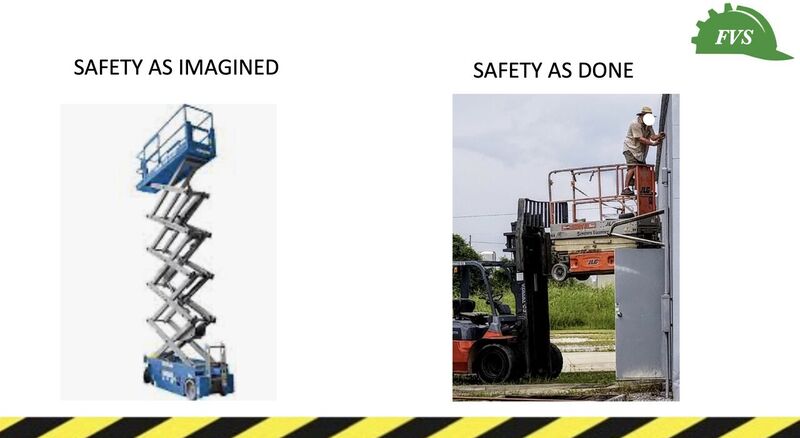
In the context of safety, it is important to analyse in detail SAI (“Safety as Imagined») versus SAD (“Safety As Done”)
If I open (or find) the book of the perfect safety. The SAI concept refers to :
👉 Perfect safety documentation: Policy, Manual, Procedures, SOP…
👉 Perfect risks analyses and management of risks based on the 10 key principles of prevention.
👉 Perfect preventives measures with risk elimination.
👉 Perfect human behavior with full compliance to rules and procedures (In this case, the name is ROBOT ..)
SAD (“Safety As Done)” is the real word application. It means practical, real time activities and how the safety protocols are practically executed in the workplace. The SAD concept refers to :
🔍 Execution: Safety procedure during the daily work with variabilities, problem, adaptation, environmental conditions and so on.
🔍 Human factors: individual perceptions, decision-making processes, impact of mental conditions (stress…) physical conditions (age, fatigue, health…) These factors can significantly affect how safety procedures are applied. Individual’s and collectives’ experiences, skills and competences are also key factors.
🔍 Communication, understanding within teams and collaboration impact the overall safety performance.
The key question is how to (try) align SAI with SAD. Only few recommendations :
➡️ Develop clear and practical SOP with the operational persons.
➡️ Go on the field to observe, exchange, provide feedback (positive) and improve the SOP
➡️ Develop good practices and transform in standard, again and again.
➡️ Review on a regular base the standard. Standard must be never fix !
➡️ Communicate and train clearly and consistently to all levels of the organization.
➡️ Ensure that employees understand the reasoning behind safety measures (explain the WHY ! ) and how to implement them in their daily tasks.
➡️ Develop employee involvement and participation to safety practices and SOP.
➡️ Identify and address deviations with analyze of deep root causes including human factors and organizations causes.
➡️ Develop REX for any deviations.
𝗙𝗶𝗻𝗮𝗹𝗹𝘆, 𝗱𝗲𝘃𝗲𝗹𝗼𝗽 𝗮 𝘀𝗮𝗳𝗲𝘁𝘆 𝗰𝗼𝗻𝘁𝗶𝗻𝘂𝗼𝘂𝘀 𝗶𝗺𝗽𝗿𝗼𝘃𝗲𝗺𝗲𝗻𝘁 𝗰𝘂𝗹𝘁𝘂𝗿𝗲 𝘄𝗶𝘁𝗵 𝗮 𝗷𝘂𝘀𝘁 𝗮𝗻𝗱 𝗳𝗮𝗶𝗿 𝗮𝗽𝗽𝗿𝗼𝗮𝗰𝗵.